


About Karate
What is Karate?
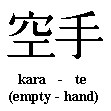
Karate is a system of self defence and physical culture originally developed and refined in Okinawa and Japan. The word is formed from the Japanese words Kara (empty) and Te (hand),symbolising that its practitioners - Karateka - are unarmed, but use their hands and feet for blocking and striking. Training is conducted within an environment based on certain Japanese cultural practices.
There are several fundamental styles of Karate. They use slightly different training methods and place varying degrees of emphasis on factors such as the speed, strength and range of techniques - thus you will hear some described as 'fast' styles, others as 'strong' styles. Shotokan is a style of Karate, which emphasises a balanced development of all these aspects, taught within a system, which instills confidence and self-control.
Brief History of Shotokan
In 1609 Japan invaded Okinawa, and further to the ban on weaponry, placed a ban upon anyone doing martial arts, and so martial arts training became shrouded in secrecy. Over three hundred years two styles evolved, Shorin-ryu which developed from Shuri and Tomari and Shorei-ryu which came from Naha. It is believed that Shorin-ryu was best for smaller men, with a light and fast style. Shorei-ryu was suited to the bigger, more powerful man.
Gichin Funakoshi was born in 1868 and began studying martial arts at a very young age, under Anko Itosu and Yasutsune Azato. The ban on martial arts still stood, and so Funakoshi would often have lessons with his instructors at night time, so not to be discovered. Tode, the martial arts of Okinawa could also be pronounced 'kara' and Funakoshi gave this the alternative meaning of 'empty' and so his training became known as Karate.
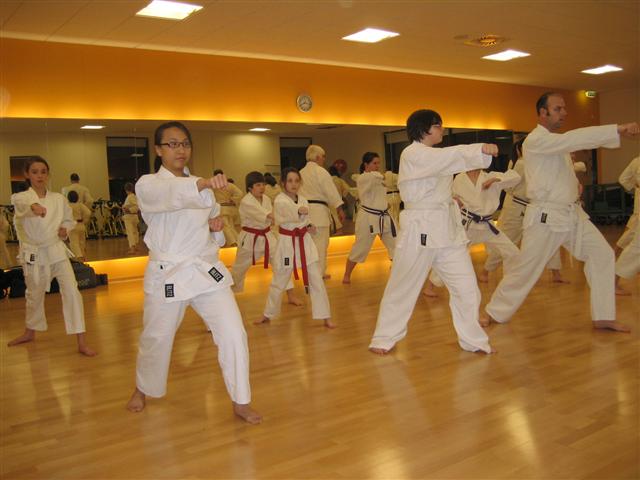
The ban on martial arts was finally lifted in 1902 when Shintaro Ogawa, the Commissioner of Education recommended that martial arts should be included in physical education in the first middle school of Okinawa. This meant that Funakoshi could continue his training in without fear of discovery, and he could now spread the word of his karate.
Funakoshi was invited to Japan in 1922 to give a demonstration of Karate at the First National Athletic Exhibition in Tokyo, which was organised by the Ministry of Education. After this demonstration he decided to remain in Japan to spread the word. It is thanks to his efforts that Karate became part of the school curriculum in Japan.
The style name Shotokan was given to Funakoshi's karate by his students. Shoto was Funakoshi's pen name as a writer, meaning 'pine waves' and Kan means 'school' so those who trained at Funakoshi's 'school' became known as the Shotokan. In 1948 Funakoshi established the Japan Karate Association and he remained the head of the JKA until his death in 1957.
Nakayama was a senior student of the JKA and took over the role of head of the Association. Nakayama began studying Shotokan under Funakoshi Sensei, at Takushoku University in 1932. Now Nakayama is held responsible for the worldwide development of Shotokan Karate. Nakayama developed a way of logically teaching karate. He decided that it was best to devise a way of teaching different abilities easily. He developed the instructor programme and karate's first ever match system.
It is thanks to Nakayama Sensei that karate is as successful a martial art as it is today. Nakayama Sensei passed away in 1987, at the age of 74